LaTeX/Presentations : Différence entre versions
m (→simplest beamer code) |
|||
| Ligne 1 : | Ligne 1 : | ||
<noinclude>{{LaTeX/Top}}</noinclude> | <noinclude>{{LaTeX/Top}}</noinclude> | ||
| − | '''Beamer''' is a [[LaTeX]] class for creating slides for presentations | + | '''Beamer''' is a [[LaTeX]] class for creating slides for presentations. The name is taken from the German word Beamer, a pseudo-anglicism for video projector. |
| − | + | It has special syntax for defining 'slides' known in Beamer as 'frames'. Slides can be built up on-screen in stages as if by revealing text that was previously hidden or covered. This is handled with [[PDF]] output by creating successive pages that preserve the layout but add new elements, so that advancing to the next page in the PDF file appears to add something to the displayed page, when in fact it has redrawn the page. | |
| − | + | ||
| − | + | ||
| − | + | ||
| − | + | ||
Beamer provides the ability to make 'handouts', that is a version of the output suitable for printing, without the dynamic features, so that the printed version of a slide shows the final version that will appear during the presentation. For actually putting more than one frame on the paper, pgfpages package is to be used. | Beamer provides the ability to make 'handouts', that is a version of the output suitable for printing, without the dynamic features, so that the printed version of a slide shows the final version that will appear during the presentation. For actually putting more than one frame on the paper, pgfpages package is to be used. | ||
| Ligne 13 : | Ligne 9 : | ||
An "article" version is also available, rendered on standard sized paper (like A4 or letter), with frame titles used as paragraph titles, no special slide layout/colors, keeping the sectioning. This version is suitable for lecture notes or for having a single source file for an article and the slides for the talk about this article. | An "article" version is also available, rendered on standard sized paper (like A4 or letter), with frame titles used as paragraph titles, no special slide layout/colors, keeping the sectioning. This version is suitable for lecture notes or for having a single source file for an article and the slides for the talk about this article. | ||
| − | |||
| + | =First step= | ||
| + | Let's start with a simple 3 slides presentation including one for the title. | ||
| − | |||
<source lang="latex"> | <source lang="latex"> | ||
| Ligne 45 : | Ligne 41 : | ||
</source> | </source> | ||
| + | |||
| + | |||
| + | |||
| + | |||
| + | |||
| + | |||
| + | |||
=See previous part= | =See previous part= | ||
Version du 29 mai 2011 à 13:34

Beamer is a LaTeX class for creating slides for presentations. The name is taken from the German word Beamer, a pseudo-anglicism for video projector.
It has special syntax for defining 'slides' known in Beamer as 'frames'. Slides can be built up on-screen in stages as if by revealing text that was previously hidden or covered. This is handled with PDF output by creating successive pages that preserve the layout but add new elements, so that advancing to the next page in the PDF file appears to add something to the displayed page, when in fact it has redrawn the page.
Beamer provides the ability to make 'handouts', that is a version of the output suitable for printing, without the dynamic features, so that the printed version of a slide shows the final version that will appear during the presentation. For actually putting more than one frame on the paper, pgfpages package is to be used.
An "article" version is also available, rendered on standard sized paper (like A4 or letter), with frame titles used as paragraph titles, no special slide layout/colors, keeping the sectioning. This version is suitable for lecture notes or for having a single source file for an article and the slides for the talk about this article.
First step
Let's start with a simple 3 slides presentation including one for the title.
\documentclass{beamer}

\title{Demography}
\author{I. Ned}\institute{Institut National d'Etudes D\'emographiques}


\begin{document}

\begin{frame}
\titlepage
\end{frame}

\begin{frame}
Text located on the first content slide
\end{frame}

\begin{frame}
Text located in the second content slide
\end{frame}

\end{document}
See previous part
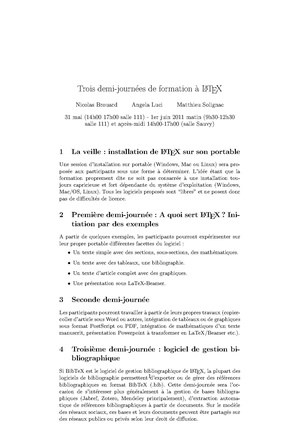
You may use a Powerpoint Fichier:Powerp.ppt
External links
- Beamer home page
- Beamer SourceForge project page (no longer maintained)
- beamerposter - a beamer extension for scientific conference posters in DIN-A0 size or bigger
- Till Tantau, Joseph Wright, Vedran Miletić (2010) User's guide - from www.ctan.org
- Beamer Theme Matrix
- wiki2beamer: Tool to create Beamer presentations from a wiki-like syntax
- Dohmen, Klaus (2010) Dual Screen Presentations with the LaTeX Beamer Class under X - from The PracTeX Journal
- Beamer2Thesis - a beamer extension for presenting a thesis
Tutorials
- Introduction to Beamer - How to make a presentation
- A tutorial with examples on the usage of Beamer Latex class
- Another tutorial
- Beamer by Example from PracTEX Journal, many examples of both TeX source and formatted output
- Introduction to beamer on wikibooks
- A presentation using the LaTeX Beamer class (short guide - samples)

